


Resource use is at the centre of the triple planetary crisis with resource extraction and processing accounting for over 55% of global greenhouse gas emissions[1], making implementation of the circular economy critical to achieve net-zero and other sustainability objectives. This above report focuses on the nexus between circular economy and climate mitigation. It outlines steps for signatories to the Principles for Responsible Banking and net-zero committed financial institutions to effectively embed circular solutions in their climate transition plans to achieve climate mitigation targets, including by increasing financing for circular solutions and opportunities, and through advocacy and partnerships with policymakers to enhance circularity.
This report is supported by four sector supplements, guiding banks to develop sector-specific financing action plans that promote circular economy principles in high impact sectors with significant circularity potential, namely agrifood, buildings and construction, textiles, and metals and minerals (coming soon).
These resources are part of the “Circular Economy as an Enabler for Responsible Banking” series that supports banks in operationalizing the interlinkages between circular economy and climate, nature, pollution, and healthy and inclusive economies. They are designed for signatories to the Principles for Responsible Banking to move from target-setting for sustainability objectives to delivering on their commitments.
Click to navigate the sector supplements:
Circular Solutions to Achieve Climate Targets in Minerals and Metals Value Chains
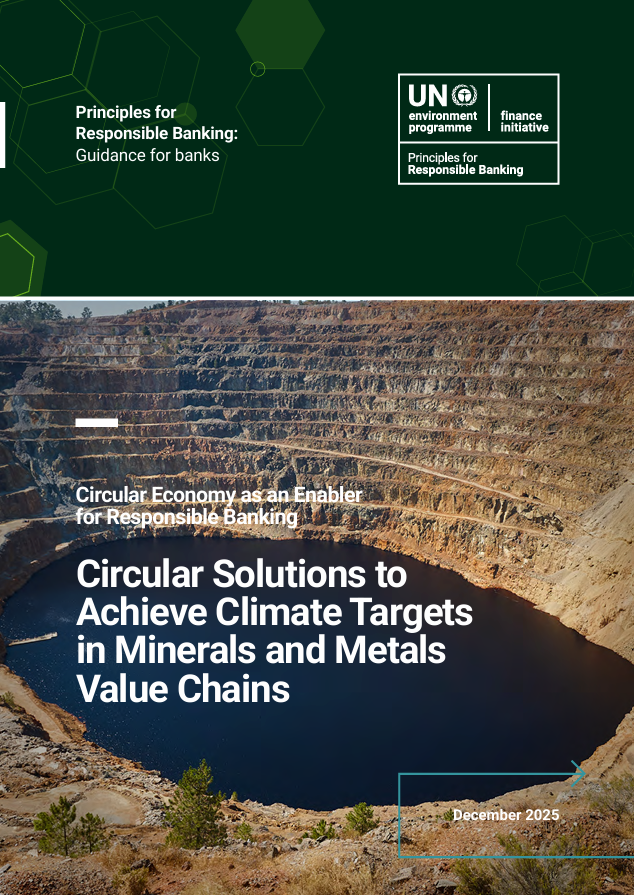
The metals and mining sector is at the forefront of the global transition to a low-carbon and digital economy, driven by the increasing demand for materials essential to clean energy supply (solar and wind), meeting market/consumer appetite (EVs and heat pumps), and delivering connectivity (batteries, grids, digitization and AI). The mining industry accounts for an estimated 4–7% of global GHG emissions annually, with additional 8–9% coming from the metals industry, mainly through steel and aluminium production[2]. By 2040, demand for key metals critical to the energy transition could increase by up to four times[3]. Despite its critical role in achieving the goals of the Paris Agreement on Climate Change, the sector’s heavy reliance on fossil fuels and resource-intensive processes have resulted in substantial carbon emissions and widespread environmental, social and human rights impacts.
This guidance is designed to assist banks in integrating circular solutions in the metals and mining sector as part of their climate transition plans to achieve net zero emissions, through a reduction of their financed emissions and transition finance strategies. Focusing on four key metals throughout their life cycle, including copper, nickel, aluminium, and iron and steel, this guidance explores specific areas of action in all four UN Principles for Responsible Banking (PRB) categories—policies, processes and culture; client engagement; portfolio composition and financing; and stakeholder engagement and partnerships. Download the paper here.
Circular Solutions to Achieve Climate Targets in the Agrifood Sector
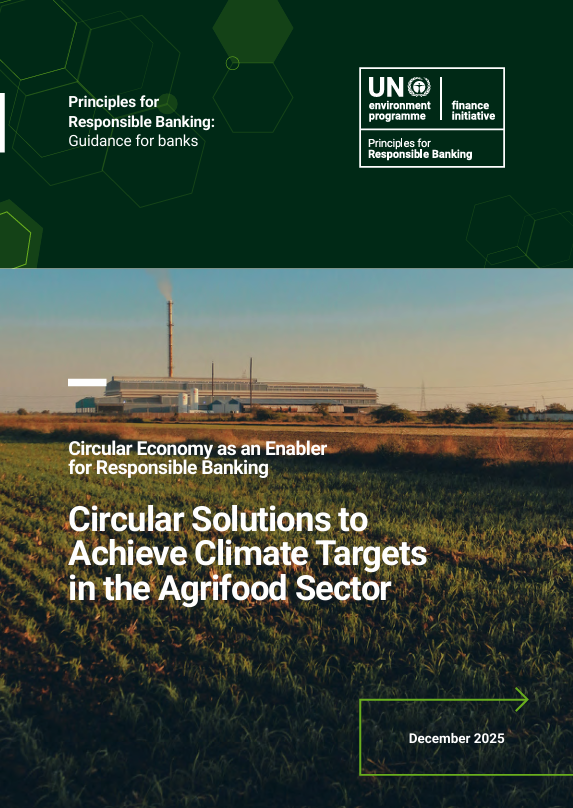
The global agrifood sector is fundamental to sustaining human life and livelihoods, providing essential nourishment and employment to billions of people worldwide. While indispensable for global economic stability and food security, the agrifood sector is a main driver of environmental damage worldwide[4]. It currently accounts for about a third of global greenhouse gas (GHG) emissions. Without intervention, these emissions could rise by 60–90% by 2050 due to population growth and increased animal-source diets[5]. The sector thus faces a critical challenge: balancing the urgent need for global food security with the pressing demand for environmental sustainability.
This guidance is designed to assist banks in integrating circular solutions in the agrifood sector as part of their climate transition plans to achieve net-zero emissions or climate mitigation targets, through a reduction of their financed emissions and through transition finance strategies. Additionally, it explores specific areas of action in all four UN Principles for Responsible Banking (PRB) categories— policies, processes. and culture; client engagement; portfolio composition and financing; and stakeholder engagement and partnerships. Download the paper here.
Circular Solutions to Achieve Climate Targets in the Buildings and Construction Sector

The buildings and construction sector contributes significantly to global climate change, accounting for approximately 21 per cent of global GHG emissions and 37 per cent of global CO2 emissions, making the sectorkey in addressing emissions reduction.[6] Circular solutions offer a viable pathway to reduce emissions across the whole life cycle of buildings.
This paper is designed to assist signatories to the UN Principles for Responsible Banking and climate mitigation committed financial institutions in integrating circular solutions in the buildings and construction sector as part of their climate transition plans to achieve net-zero emissions or climate mitigation targets, though a reduction of their financed emissions and through transition finance strategies. Further, it explores specific areas of action in internal policies, processes and culture, client engagement, portfolio composition and financing, and stakeholder engagement and partnerships. Download the paper here.
Circular Solutions to Achieve Climate Targets in the Textile Sector
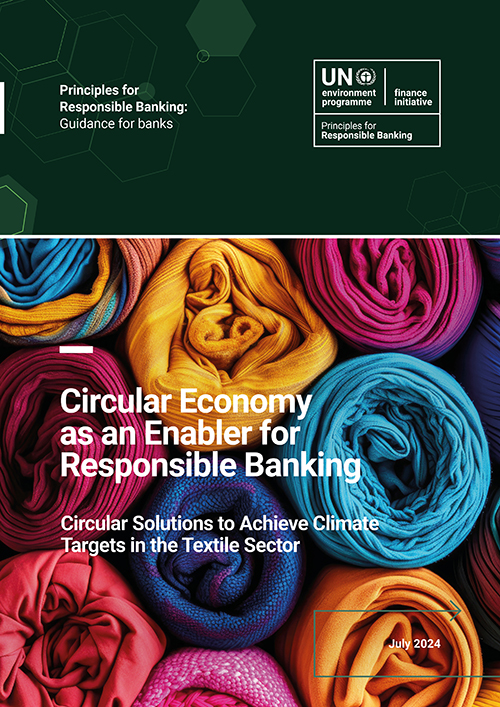
The global textile sector is one of the most polluting industries in the world and significantly contributes to climate change, with around 70 per cent of environmental impacts originating from upstream activities like raw materials extraction and production, and 30 per cent from downstream retail operations and use-phase activities[7]. Moving to circular textile business models not only offers significant potential to decarbonize the sector, it could also generate USD 700 billion in economic value by 2030.[8]
This paper is designed to assist signatories to the Principles for Responsible Banking and climate mitigation committed financial institutions in integrating circular solutions in the textile sector as part of their climate transition plans to achieve net-zero emissions or climate mitigation targets, though a reduction of their financed emissions and through transition finance strategies. Further, it explores specific areas of action in internal policies and processes, client engagement, portfolio composition and financial flows, and advocacy and partnerships. Download the paper here.
The PRB circular economy guidance can be translated into detailed, activity‑level screening methodologies using UNEP FI’s Circular economy finance guidelines for commercial banks and development finance institutions, which help banks classify, structure and monitor specific transactions and portfolios in the textile and agriculture sectors, as well as buildings and construction, minerals and metals, and plastics (coming soon). Read more and download the guidelines here.
[1] UNEP, International Resource Panel (2024). Global Resource Outlook 2024. Available at: unep.org/resources/Global-Resource-Outlook-2024
[2] McKinsey (2020). Climate risk and decarbonization: What every mining CEO needs to know, 28 January. mckinsey.com/capabilities/sustainability/our-insights/climate-risk-and-decarbonization-what-every-mining-ceo-needs-to-know#/
[3] International Energy Agency (2024). Recycling of Critical Minerals. Strategies to scale up recycling and urban mining. A World Energy Outlook Special Report. iea.org/reports/recycling-of-critical-minerals
[4] Willett, W., and others (2019). Food in the Anthropocene: The EAT–Lancet commission on healthy diets from sustainable food systems. The Lancet, 393(10170), 447–492. Available at: link.springer.com/article/10.1007/s12571-020-01093-0#ref-CR179
[5] UNEP (2022). Emissions Gap Report 2022. Available at: unep.org/resources/emissions-gap-report-2022
[6] UNEP (2024). Mainstreaming sustainable solutions to cut emissions from the buildings sector. Available at: wedocs.unep.org/bitstream/handle/20.500.11822/45095/global_status_report_buildings_construction_2023.pdf?sequence=3&isAllowed=y
[7] McKinsey & Company (2020). Fashion on Climate: How the Fashion Industry Can Urgently Act to Reduce its Greenhouse Gas Emissions. Available at: mckinsey.com/~/media/mckinsey/industries/retail/our%20insights/fashion%20on%20climate/fashion-on-climate-full-report.pdf
[8] UNEP (2020). Sustainability and Circularity in the Textile Value Chain: A Global Roadmap. Available at: oneplanetnetwork.org/sites/default/files/2023-10/Full%20Report%20-%20UNEP%20Sustainability%20and%20Circularity%20in%20the%20Textile%20Value%20Chain%20A%20Global%20Roadmap.pdf