
19 December 2023Banking, Climate Change, Impact, Insurance, Investment, Nature, News, Policy, Pollution & Circular Economy, Social
POPULAR CONTENT
19 December 2023Banking, Climate Change, Impact, Insurance, Investment, Nature, News, Policy, Pollution & Circular Economy, Social

19 December 2023Climate Change, News

18 November 2012News
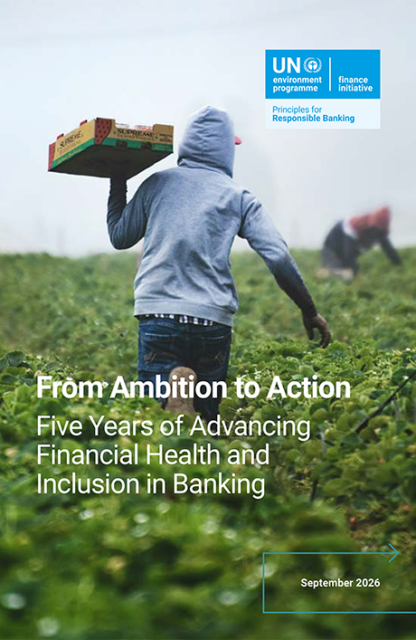
Our new report, “From Ambition to Action: Five Years of Advancing Financial Health and Inclusion in Banking", looks at how banks involved with the Principles for Responsible Banking Commitment to Financial Health and Inclusion are putting financial health and inclusion into practice including case study examples across five areas: strategy, internal policies & processes, portfolio composition & financing, client engagement and advocacy & partnerships.
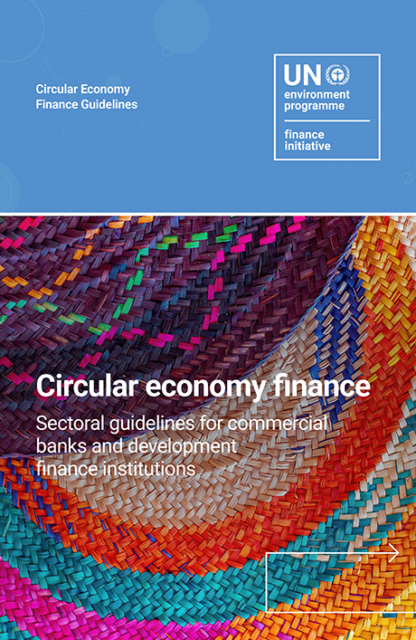
This series of guidelines equips commercial banks and DFIs with a practical methodology to assess the circularity of client activities across portfolios and client segments across the textile, agriculture and buildings and construction sectors, as well as minerals and metals (coming soon). The guidelines help institutions determine which activities are circular and, where circularity criteria are not yet met, identify targeted engagement opportunities to support clients’ transition toward more circular business models.
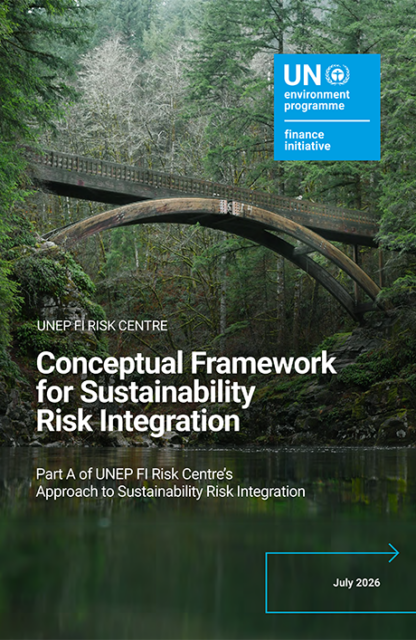
This conceptual framework sets out how sustainability risks should be considered across the seven core elements of risk management: risk strategy, governance, risk identification, measurement and materiality, risk taxonomy and scope, risk appetite, risk management actions, and risk monitoring and reporting. Its purpose is to help banking risk professionals integrate sustainability risks fully into their risk management frameworks, enabling them to meet evolving regulatory expectations while strengthening resilience, safeguarding capital, and supporting better-informed decision-making.
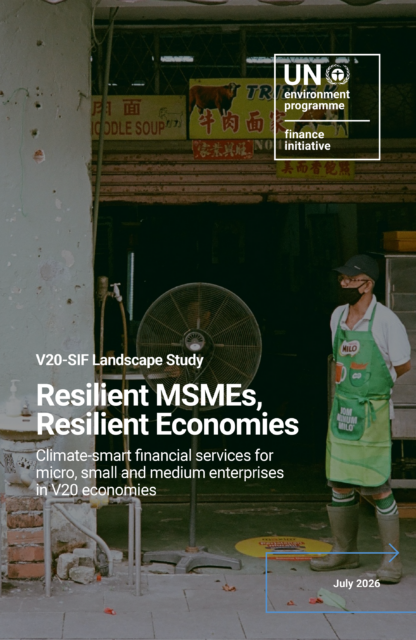
The V20 Sustainable Insurance Facility (V20-SIF), implemented under the PSI, has released its Landscape Study. Drawing on surveys and interviews with financial institutions across V20 economies, the report sets out a pragmatic and replicable approach to strengthening the climate resilience of MSMEs.
The Impact Radar is a structured compilation of sustainability topics designed to help organizations identify, assess and manage their positive…
The Sector Impact Matrix is the new iteration of UNEP FI’s flagship Sectors Mapping. Developed in collaboration with partners from…
The Adaptation Finance Taxonomy Playbook translates existing taxonomy approaches and technical guidance into practical, decision-useful tools that financial institutions can apply in real-world settings. By clarifying definitions, offering step-by-step guidance, and illustrating application through case studies, the Playbook enables financial institutions to more effectively identify, assess and scale adaptation finance opportunities across jurisdictions.
Climate shocks, nature loss, pollution, and social pressures are affecting markets, asset values, and financial stability, and regulators worldwide are tightening expectations for how banks identify, measure, and manage these risks. This report, aimed at risk professionals at banks, assesses the extent to which sustainability risks are being integrated by the global banking sector.
As physical climate risks intensify and transition-related risks reshape markets, regulation and investment landscapes, insurers face growing pressure to align…
Mental health impacts are emerging as a significant yet often overlooked consequence of climate change. From extreme weather events and…