
19 December 2023Banking, Climate Change, Impact Centre, Insurance, Investment, Nature, News, Policy, Pollution & Circular Economy, Social
POPULAR CONTENT
19 December 2023Banking, Climate Change, Impact Centre, Insurance, Investment, Nature, News, Policy, Pollution & Circular Economy, Social

18 November 2012News

19 December 2023Climate Change, News
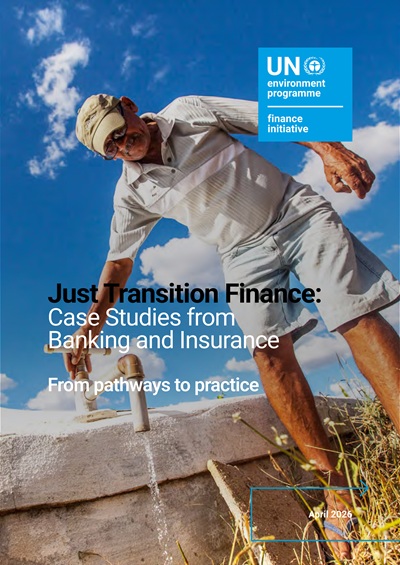
Banking, Climate Change, Insurance, Publications, Social | 02 April 2026
This report draws on the UNEP FI Just Transition Pilot Programme – a yearlong initiative that convened over a dozen banks and insurers for peer exchange and expert input – to document how just transition considerations are being integrated across banking and insurance.
Europe, Events, Impact Centre, PRB Implementation, Webinars | 30 March 2026
Following the recent updates to the ESRS under the Omnibus simplification package, this webinar explores how banks can translate evolving…

Banking, Europe, Impact Centre, Principles for Responsible Banking, Publications | 27 March 2026
The ESRS Disclosure Module converts and displays the outputs of the UNEP FI Impact Analysis Tool in alignment with ESRS language and requirements regarding materiality assessment.
Banking, Europe, Impact Analysis, Impact Centre, PRB Implementation, Principles for Responsible Banking, Publications | 27 March 2026
The Guidance explains how ESRS requirements apply to banks and how UNEP FI resources can support implementation.
Banking, Europe, Impact Analysis, Impact Centre, Publications | 27 March 2026
The UNEP FI-ESRS Topics Mapping serves to understand how the ESRS topics and sub-topics map to the Impact Areas and Impact Topics of the UNEP FI Impact Radar and vice versa.
Asia Pacific, Climate Change, Events, Insurance, Nature | 17 March 2026
The Insurance for Nature-Positive Leadership Forum will bring together leaders from insurance, government and finance to explore how nature-based solutions can reduce risk, strengthen resilience and support long-term insurability. Held in the lead-up to CBD COP17, the forum will focus on practical approaches to scaling nature-based risk reduction through insurance, policy and investment.

Asia Pacific, Events, Insurance, Nature | 16 March 2026
The 1st UNEP Asia-Pacific Transition Insurance Summit, hosted by the Monetary Authority of Singapore (MAS) with UNEP and SSFA, will convene insurers, investors and regulators to discuss transition planning, real-economy engagement, rising physical risks and emerging insurability challenges across the Asia-Pacific region.

Podcasts, Policy | 12 March 2026
In the latest episode of Financing the Future, we speak to Frank Elderson, Member of the Executive Board of the…

Asset Owner Alliance, Climate Change, Industries, Investment, Publications, Themes | 06 March 2026
NZAOA releases the fifth version of foundational document the Target-Setting Protocol reflecting NZAOA's commitment to continuous improvement.
Events, Latin America & Caribbean, Policy, Webinars | 03 March 2026
En esta sesión del Programa de Apoyo a la Implementación Regulatoria (RISP), expertos del Consejo de Normas Internacionales de Sostenibilidad (ISSB) y la Red para la Ecologización del Sistema Financiero (NGFS) ofrecerán perspectivas a los miembros y partes interesadas de UNEP FI sobre su orientación para la implementación y divulgación de planes de transición.
