
19 December 2023Banking, Climate Change, Impact Centre, Insurance, Investment, Nature, News, Policy, Pollution & Circular Economy, Social
POPULAR CONTENT
19 December 2023Banking, Climate Change, Impact Centre, Insurance, Investment, Nature, News, Policy, Pollution & Circular Economy, Social

18 November 2012News

19 December 2023Climate Change, News
Europe, Events, Impact Centre, PRB Implementation, Webinars | 30 March 2026
Following the recent updates to the ESRS under the Omnibus simplification package, this webinar explores how banks can translate evolving…

Banking, Europe, Impact Centre, Principles for Responsible Banking, Publications | 27 March 2026
The ESRS Disclosure Module converts and displays the outputs of the UNEP FI Impact Analysis Tool in alignment with ESRS language and requirements regarding materiality assessment.
Banking, Europe, Impact Analysis, Impact Centre, PRB Implementation, Principles for Responsible Banking, Publications | 27 March 2026
The Guidance explains how ESRS requirements apply to banks and how UNEP FI resources can support implementation.
Banking, Europe, Impact Analysis, Impact Centre, Publications | 27 March 2026
The UNEP FI-ESRS Topics Mapping serves to understand how the ESRS topics and sub-topics map to the Impact Areas and Impact Topics of the UNEP FI Impact Radar and vice versa.
Banking, Climate Change, Pollution & Circular Economy, Principles for Responsible Banking, Publications | 17 December 2025
This series focuses on the nexus between circular economy and climate mitigation, outlining steps for banks to effectively embed circular solutions in their climate transition plans to achieve their net-zero and climate mitigation targets. It includes four sector supplements, guiding banks to develop sector-specific financing action plans that promote circular economy principles in high impact sectors with significant circularity potential, namely agrifood, buildings and construction, textiles, and metals and minerals.

Banking, Climate Change, PRB Guidance, Principles for Responsible Banking, Publications | 20 November 2025
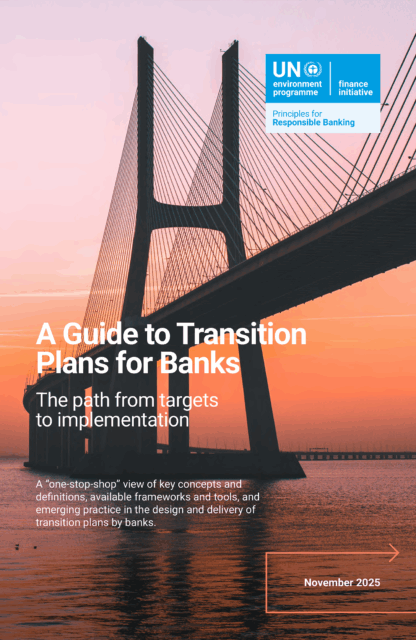
Transition planning is not only a regulatory or market-driven requirement—it is a core enabler of a bank’s portfolio composition, client engagement, and stakeholder and partnership strategies. In addition, transitioning planning helps banks respond to their climate, nature, human rights and healthy and inclusive economies commitments under the PRB. This report equips banks with the tools to embed sustainability into their core business models, enhance internal coordination, and proactively support the real economy’s transformation—delivering long-term value for both society and shareholders.
Banking, News, Principles for Responsible Banking | 19 November 2025
UNEP FI and PRB signatories had a strong presence in the lead-up to COP30 and on the ground in Belém demonstrating how the responsible banking community are demonstrating leadership in advancing climate and nature goals.

Banking, News, Principles for Responsible Banking | 18 November 2025
On 6 November 2025, UNEP FI and MSCI Institute convened at the PRI in Person event in São Paulo. Joined by leaders from Harvard, Amundi, and Itaú, the panel discussion drew on MSCI’s analysis of PRB member banks, exploring the financial implications of sustainability commitments. The session presented a deep dive into how responsible banking correlates with stronger ESG performance and lower cost of capital, with broader relevance across sectors and investment strategies. In conclusion, responsible banking practices, when embedded and rigorous, were shown to deliver not just positive societal impact but tangible business value.

Banking, News, Principles for Responsible Banking | 15 October 2025
UNEP FI marks the release of the UN Principles for Responsible Banking’s third biennial progress report, “Responsible Banking: A Six Year Journey of Systemic Change.”
Banking, News, Principles for Responsible Banking | 15 October 2025
The 3rd PRB Progress Report highlights how PRB signatories are increasingly moving from commitment to action, embedding sustainability into core business strategies, governance, and client relationships to manage risk, meet stakeholder expectations, to remain competitive in an evolving economy challenged by climate change and where over 50% of global GDP is dependent on nature.