19 December 2023Banking, Climate Change, Impact Centre, Insurance, Investment, Nature, News, Policy, Pollution & Circular Economy, Social
POPULAR CONTENT
19 December 2023Banking, Climate Change, Impact Centre, Insurance, Investment, Nature, News, Policy, Pollution & Circular Economy, Social

18 November 2012News

19 December 2023Climate Change, News
Nature, News | 28 January 2026
With USD 700 billion needed each year to protect and restore nature and over half of global economic value generation moderately or highly dependent on natural systems, closing the nature finance gap represents both a significant challenge and a major opportunity for the finance sector. As 2026 shapes up to see important moments for nature conservation and restoration, this article looks at what to look out for in nature finance over the coming months.

Nature, Publications | 22 January 2026
This guidance, co-developed with Equator Principles, supports project-related financing teams as well as risk professionals within financial institutions, particularly banks, by outlining how to conduct a nature-based risk assessment at the corporate, portfolio and project levels using existing frameworks and tools. It highlights how nature-based risk assessments can improve risk identification, strengthen due diligence, enhance collaboration with clients, and support better decision-making across project finance and portfolios.
Banking, Climate Change, Net Zero Banking, Publications | 21 January 2026
Transition plans are increasingly becoming a key focus area for policymakers and regulators across jurisdictions. At the same time, an…
Asset Owner Alliance, Climate Change, Industries, Investment | 20 January 2026

Banking, Climate Change, Net Zero Banking, Publications | 14 January 2026
The real estate sector is one of the largest contributors to global greenhouse gas (GHG) emissions, representing 34% of total carbon dioxide (CO2) emissions. It is also one of the more challenging sectors to decarbonize due to the decentralized nature of building ownership and the significant role of value chain emissions, notably from power grids and construction.
Banking, Climate Change, Net Zero Banking, Publications | 14 January 2026
The power generation sector lies at the heart of the transition needed to meet the goals of the Paris Agreement, as it underpins economy-wide electrification and decarbonization efforts. Renewable energy technologies are key to this systemic transformation, but grid congestion and modernization issues need to be addressed, storage and baseload considerations are critical and existing fossil fuel plants will need to be retrofitted.
Banking, Climate Change, Net Zero Banking, Publications | 14 January 2026
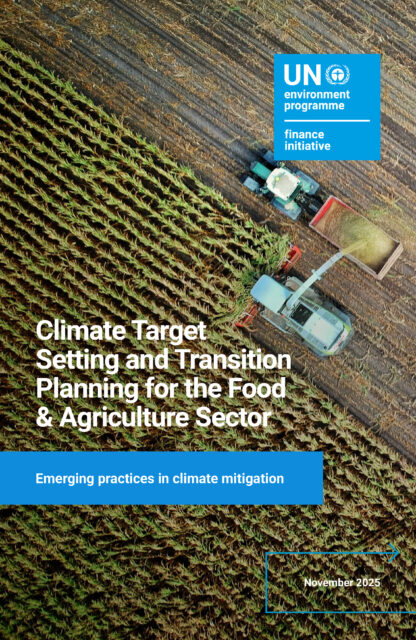
The food and agriculture sector accounts for roughly one-third of global greenhouse gas (GHG) emissions—making it both a major challenge and a critical opportunity for climate action. The most immediate gains lie in reducing on-farm emissions and in addressing land-use change emissions. These efforts can be complemented by enhancing carbon sequestration through sustainable practices.
Banking, Pollution & Circular Economy, Publications | 31 December 2025
This series helps banks addressing pollution, one of the three planetary crises alongside climate change and biodiversity loss. The first sectoral supplement offers banks a practical framework to start reducing pollution impacts and manage risks related to the buildings and construction sector within their portfolios.

Banking, Climate Change, Impact Centre, Insurance, Investment, Nature, News, Policy, Pollution & Circular Economy, Social | 19 December 2025
Find out about the accomplishments of UNEP FI throughout 2025 in this annual review article.

Events, Nature, Webinars | 17 December 2025
The largest living organism on Earth is a fungus, with the fungal kingdom playing a vital role in many aspects of life as we know it. Join us for an in-depth session, in collaboration with The Future is Fungi Award, on why fungal ecosystems are an important yet overlooked factor in sustainable finance.