19 December 2023Banking, Climate Change, Impact, Insurance, Investment, Nature, News, Policy, Pollution & Circular Economy, Social
POPULAR CONTENT
19 December 2023Banking, Climate Change, Impact, Insurance, Investment, Nature, News, Policy, Pollution & Circular Economy, Social

19 December 2023Climate Change, News

18 November 2012News
Impact, News | 07 September 2026
Have your say UNEP FI is inviting feedback on the Sector Impact Matrix as part of its ongoing development. The…

Banking, Publications, Social | 01 September 2026
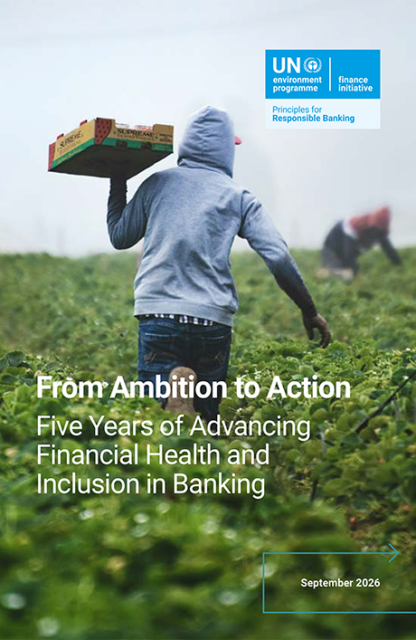
Our new report, “From Ambition to Action: Five Years of Advancing Financial Health and Inclusion in Banking", looks at how banks involved with the Principles for Responsible Banking Commitment to Financial Health and Inclusion are putting financial health and inclusion into practice including case study examples across five areas: strategy, internal policies & processes, portfolio composition & financing, client engagement and advocacy & partnerships.
Events, Pollution & Circular Economy | 21 August 2026
The World Circular Economy Forum (WCEF) 2026, taking place in Gandhinagar, India, from 15–18 September 2026, is the world's leading forum dedicated to scaling up the circular economy and bringing together stakeholders from business, governments, academia and civil society.

At COP17, UNEP FI will mobilize its network of members and partners to highlight the critical role of finance in protecting and restoring nature. Throughout the conference, UNEP FI will showcase progress on biodiversity finance since the adoption of the GBF, spotlight leading initiatives, commitments and innovations from across the finance sector, and advance dialogue on what is still needed to align global financial flows with biodiversity goals.

Climate Change, Events | 28 July 2026
During Climate Week NYC 2026, UNEP FI will bring together banks, insurers and investors to showcase the finance sector’s role in addressing climate change, nature loss and pollution. Members can engage with industry leaders, explore emerging sustainable finance strategies and help advance a resilient, sustainable and inclusive economy.

Banking, Pollution & Circular Economy, Publications | 28 July 2026
This series of guidelines equips commercial banks and DFIs with a practical methodology to assess the circularity of client activities across portfolios and client segments across the textile, agriculture and buildings and construction sectors, as well as minerals and metals (coming soon). The guidelines help institutions determine which activities are circular and, where circularity criteria are not yet met, identify targeted engagement opportunities to support clients’ transition toward more circular business models.
Banking, News, Risk | 22 July 2026
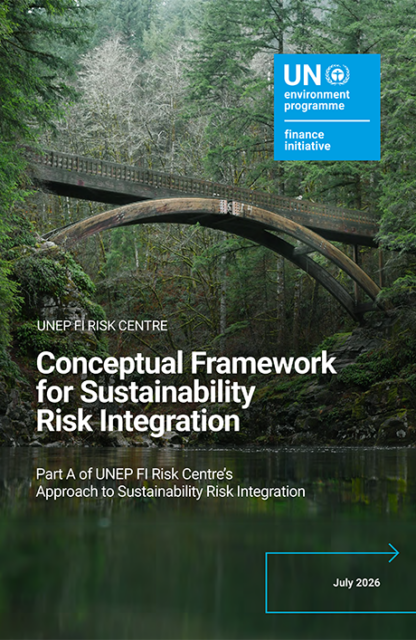
The United Nations Environment Programme Finance Initiative (UNEP FI) today launched The Conceptual Framework for Sustainability Risk Integration that sets out a practical approach to help banks embed sustainability risks into core risk management practices, in response to growing supervisory expectations and technical challenges experienced by banks.

Banking, Publications, Risk | 22 July 2026
This conceptual framework sets out how sustainability risks should be considered across the seven core elements of risk management: risk strategy, governance, risk identification, measurement and materiality, risk taxonomy and scope, risk appetite, risk management actions, and risk monitoring and reporting. Its purpose is to help banking risk professionals integrate sustainability risks fully into their risk management frameworks, enabling them to meet evolving regulatory expectations while strengthening resilience, safeguarding capital, and supporting better-informed decision-making.
Banking, Events, Global Roundtable, Insurance, Investment, Risk, Webinars | 16 July 2026
As a follow-up to the discussions at the UNEP FI Global Roundtable 2026 in June, this webinar will explore how financial institutions are enabling the real economy transition and strengthening resilience through financing, investment, and collaboration with the real economy. The session will highlight practical approaches to supporting the transition and provide participants with the opportunity to hear diverse perspectives from across the financial sector and the real economy.

Asia Pacific, Banking, Nature, News, Principles for Responsible Banking | 16 July 2026
Supporting clients in the transition to a nature-positive economy means embedding nature into client engagement, supporting clients through advice, financial products and solutions, and capacity building. This is both an environmental and strategic imperative. In Asia Pacific, where economies are closely tied to natural systems, enabling client transition can reduce portfolio risk, strengthen resilience, and unlock new business opportunities.