


This article originally appeared in Green Central Banking as a joint opinion piece from De Nederlandsche Bank (DNB)—the central bank of the Netherlands—and UNEP FI.
Today, financial institutions are confronted with the dual pressures of climate change and geopolitical volatility. Though seemingly distinct, these risk drivers share important features: both are foreseeable, yet inherently uncertain. The scale and timing of their economic impacts across complex supply chains and regions can be also difficult to quantify.
At the same time, these risks are intertwined. Geopolitical shifts can influence the pace of the green transition, while climate change and environmental degradation can become a driver of geopolitical risk. This can occur, for example, through resource scarcity, migration pressures, social unrest, and regional instability. In recognizing this connection, banks can build on their existing climate risk toolkits, including scenario analysis and stress testing, to develop a more integrated and resilient framework for managing risks from geopolitical uncertainty.
How fossil fuel dependency links climate and geopolitical risk
Roughly three-quarters of the world’s population lives in countries that are net importers of fossil fuels. This dependency is where climate and geopolitical risk most visibly converge: the reliance on fossil fuels that drive emissions also leaves economies and their financiers exposed to price shocks beyond their control, as disruptions in concentrated energy hubs, particularly for oil and gas, rapidly cascade through supply chains.
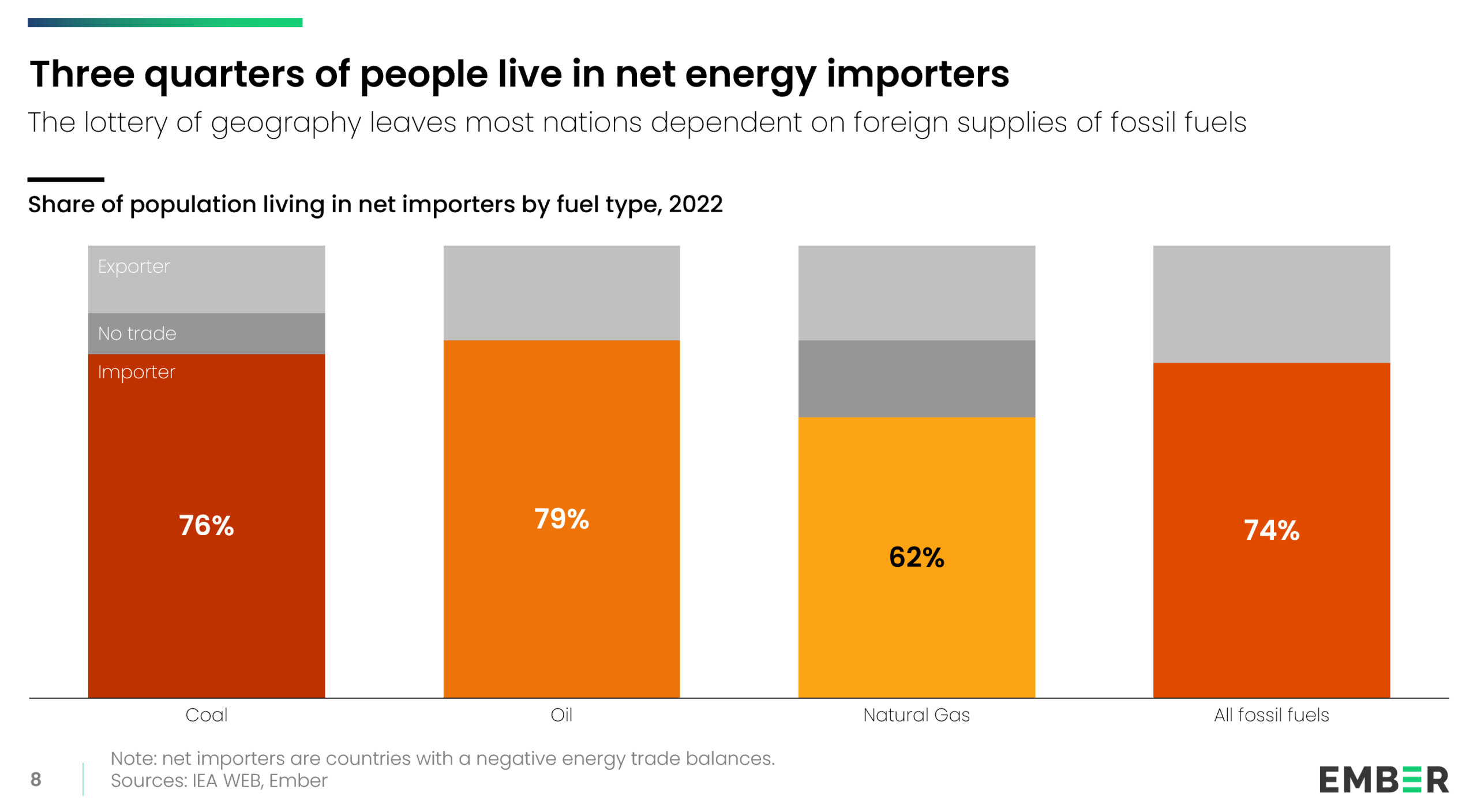 Figure 1: Share of population living in net importers by fuel type, 2022. Source: Ember, 2026
Geopolitical developments can affect financial institutions through diverse and mutually reinforcing channels. From a credit perspective, companies with a fossil-heavy energy mix face compounding risks: exposure to increasing climate transition costs, such as carbon pricing and regulatory shifts; changes in technology or market demand; and the unpredictable nature of geopolitical supply disruptions.
Over time, these pressures can extend beyond the balance sheet to clients’ business models and strategic positioning. Accelerating the energy transition can ease this dependency, though it may increase the need to manage other concentration risks, as critical minerals like lithium, copper and rare earth elements are essential for batteries and renewable infrastructure.
How geopolitical fragmentation feeds policy uncertainty
At the same time, financial institutions and their clients rely on predictable policy signals to make informed business decisions and allocate capital efficiently. An orderly transition pathway offers the stability necessary for long-term planning, as the Network for Greening the Financial System notes.
Geopolitical fragmentation and trade tensions, however, can lead some jurisdictions to prioritize short-term domestic industrial competitiveness and security concerns over long-term resilience. In this context, in fossil-fuel exporting countries, climate policy is increasingly weighed against short‑term economic and strategic interests, leading some countries to delay or recalibrate their transition measures. As a result, financial institutions and their clients can face greater uncertainty about the timelines, carbon costs and regulatory requirements on which their long-term investment decisions depend.
This is part of a broader pattern: economic policy uncertainty has risen sharply since the mid-2010s, reaching levels not seen in the past three decades.
The consequences are concrete. The repurposing of environmental subsidies or shifting trade barriers can severely impair financing conditions and increase credit risk, while for globally active financial institutions, diverging standards across borders further complicates the assessment of both transition and physical risks.
Managing climate and geopolitical risk complexities without starting from scratch
Both climate and geopolitical risks ultimately materialize through traditional credit, market and liquidity risks and extend beyond energy: drought, displacement, flooding and heat stress can disrupt productive output and strain supply chains and contribute to sovereign risk. Because these risks unfold in ways historical data cannot fully capture, purely quantitative approaches have limits, and institutions can complement them with forward-looking analysis and qualitative scenario design.
The first step for institutions is to build on what already exists. In recent years, financial institutions have invested substantially in climate risk capabilities, such as scenario analysis, which provide a natural starting point for geopolitical risk as well. Mapping supply chain dependencies and exposure to the physical impacts of climate change, stress-testing against policy shifts and identifying stranded asset risk apply equally to both. A client heavily reliant on a single commodity sourced from a climate-vulnerable or politically unstable jurisdiction, for example, presents a risk profile that existing climate risk frameworks are well-positioned to surface and address.
Supervisory practice is already moving in this direction. The European Central Bank (ECB) has embedded geopolitical risk across its supervisory methodology, and has asked banks to run reverse stress tests identifying geopolitical scenarios that could severely deplete capital. These approaches closely mirror those for climate risk. The concept of double materiality may also offer a useful lens: institutions can assess not only how geopolitical developments could affect their financial position, but also how their financing decisions may contribute to structural dependencies or instability.
The second step is to account for how climate and geopolitical risk interact—something institutions already do implicitly. A disorderly transition scenario is essentially one in which policy coordination fails, and a common reason for such failure is geopolitical. Making that driver explicit enables institutions to develop combined scenarios that reflect how different transition pathways could interact with varying degrees of geopolitical fragmentation.
There are various scenarios which could result, as defined by the degree of international cooperation and the pace of technological change, each with a distinct risk profile.
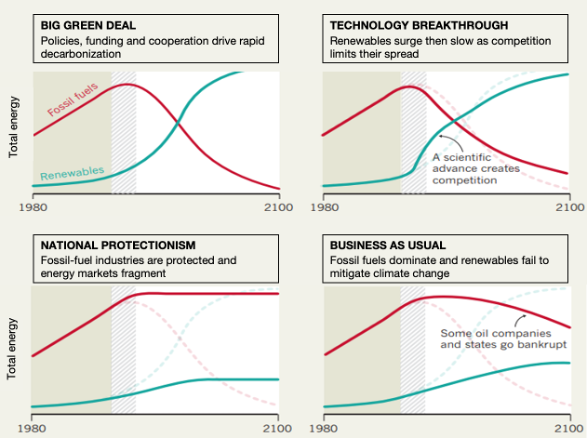
Figure 2: Stylized narrative scenarios for the energy transition under varying degrees of international cooperation and technological progress. Source: Adapted from Goldthau et al. 2019, Nature Energy, 569, 30.
Note: This figure is intended to illustrate possible pathways, not to forecast them.
Under protectionist policies, for instance, fossil-fuel industries might be shielded and energy markets could fragment, prolonging fossil fuel dependency and exposing companies to greater volatility in energy prices and supply, leading to higher risks for banks. These scenarios can then be translated into financial impacts using the stress testing tools that banks already have in place.
What’s next for climate and geopolitical risk integration
The interconnection between climate and geopolitical risks is more than an analytical challenge: it is itself a source of systemic vulnerability. Financial institutions and policymakers have already laid the analytical foundations to address this interconnection by developing extensive toolkits to assess both climate-related and geopolitical risks.
The question now is less about building new capabilities than about broadening how existing ones are applied. In practice, this will differ across institutions and jurisdictions. While geopolitical fragmentation will likely continue to present challenges, international alignment also continues through multilateral platforms across the world.
The objective is not to predict the future with precision, but to better understand where vulnerabilities lie and how they might evolve across a wider range of plausible futures. In a more uncertain and fragmented world, that broader and more integrated lens is exactly what resilience requires.