


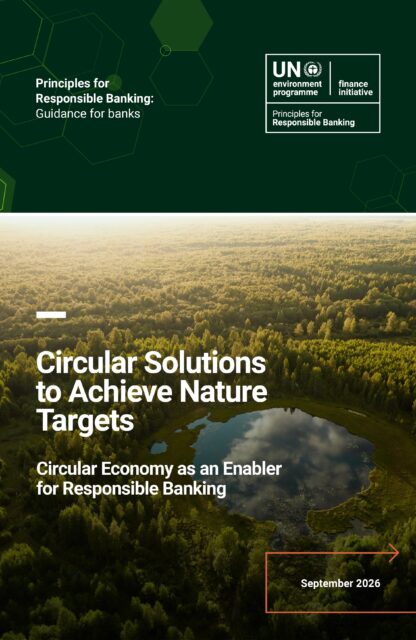
Nature loss is an increasing financial risk for banks. Circular economy approaches can help address this challenge by reducing waste and resource use, regenerating natural systems while supporting positive outcomes for nature, climate and long-term economic resilience.
Our new guidance, Circular Solutions to Achieve Nature Targets, provides commercial banks, particularly signatories to the Principles for Responsible Banking (PRB), with a practical framework for understanding how circular economy solutions can address nature-related dependencies, impacts, risks and opportunities across three ecosystem categories: ocean and marine, freshwater, and terrestrial and land-based ecosystems.
The report outlines how circular economy considerations can be integrated into governance, risk management, sector strategies and client engagement. It also highlights how banks can support clients in embedding circularity into transition plans, financing activities and nature-related strategies and targets.
The guidance identifies high-impact sectors for portfolio screening and prioritisation and recommends actions across four key areas:
- Policies, processes and culture
- Client engagement
- Portfolio composition and financing
- Stakeholder engagement and partnerships
These are supported by case studies from banks illustrating emerging practices across these areas for the three ecosystems.
The report’s approach supports alignment with the Kunming-Montreal Global Biodiversity Framework and can be adapted to different regulatory and market contexts. It can also help banks implement and advance their PRB nature targets.
Learn more by downloading the report here.
To understand the interlinkages between circularity and climate, nature, pollution and inclusive economies, as well as with the four Principles for Responsible Banking action categories (internal policies, client engagement, portfolio, advocacy), please consult the Circular Economy as an Enabler for Responsible Banking series, including the report Circular Solutions to Achieve Climate Targets and supplements on the agrifood, buildings and construction, and textile sectors.