19 December 2023Banking, Climate Change, Impact, Insurance, Investment, Nature, News, Policy, Pollution & Circular Economy, Social
POPULAR CONTENT
19 December 2023Banking, Climate Change, Impact, Insurance, Investment, Nature, News, Policy, Pollution & Circular Economy, Social

19 December 2023Climate Change, News

18 November 2012News
Banking, Principles for Responsible Banking, Publications, Risk | 21 September 2026
A Chief Risk Officer’s Guide to the Principles for Responsible Banking explains how CROs and their teams can implement the PRB through the bank’s existing risk management framework. It connects each of the six Principles to the core elements of risk management, with practical actions, questions to ask, and case studies from signatory banks.
Blue Finance, Nature, Publications | 18 September 2026
The Ocean Investment Protocol offers a framework for financial institutions, policy makers and industry leaders to lead this transition. First published in 2025, this updated edition reflects developments in the sustainable ocean finance landscape and highlights new priorities; including stronger action by central banks, regulators, and supervisors and better integration of ocean considerations into financial decision-making.
Asset Owner Alliance, Climate Change, Investment, News | 17 September 2026
Updated NZAOA Call to Action gives clear guidance on what some of the world's largest asset owners look for from firms managing their private market investments

Asset Owner Alliance, Investment, Publications | 17 September 2026
This guidance gives asset owners and managers a shared foundation for clearer, more consistent dialogue.
Climate Change, Insurance, News | 17 September 2026
UNEP and the Insurance Association of Türkiye (TSB) will co-host the flagship COP31 Global Sustainable Insurance Summit on 13-14 November 2026 at the Insurance House during the UN Climate Change Conference in Antalya, Türkiye.

Banking, Nature, Publications, Risk | 16 September 2026
This guide helps risk professionals at banks gather the information they need to monitor and manage nature-related risks and opportunities across their portfolios. Structured around ten questions, the guide helps banks better understand their nature-related impacts, capabilities, and management practices – and turn that understanding into greater resilience and future opportunities.
Climate Change, Events | 10 September 2026
UNEP FI will organize and contribute to a range of events throughout COP31, with Finance Day scheduled to take place on 13 November 2026. Details of our activities, publications and events will be added to this page as they are confirmed.

Banking, Nature, News, Pollution & Circular Economy | 10 September 2026
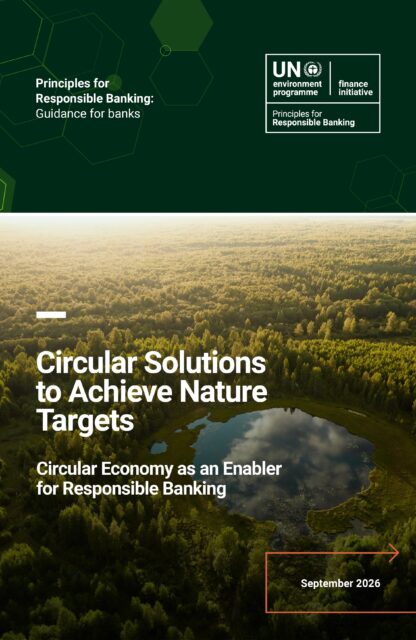
The new "Circular Solutions to Achieve Nature Targets" guidance aims to help banks address nature-related impacts and dependencies by integrating circular economy considerations across their portfolios and operations. Focusing on three ecosystems - ocean and marine, freshwater, and terrestrial and land ecosystems - it provides examples of high-impact sectors to address, practical actions for institutions to take and case studies illustrating emerging banking practices.

Banking, Nature, Pollution & Circular Economy, Principles for Responsible Banking, Publications | 10 September 2026
This report provides commercial banks, particularly signatories to the Principles for Responsible Banking (PRB), with a practical framework for understanding how circular economy solutions can address nature-related dependencies, impacts, risks and opportunities across three ecosystem categories: ocean and marine, freshwater, and terrestrial and land-based ecosystems.
News, Risk | 08 September 2026
Over the past decade and a half, banks have significantly strengthened their risk management frameworks. In the wake of the global financial crisis in 2008, institutions invested heavily in governance, controls, stress testing, and capital adequacy to better manage credit, market, liquidity and operational risks. Today, however, a new category of risk drivers is reshaping the landscape: sustainability-related risks related to climate change, nature loss, pollution and social pressures.