
19 December 2023Banking, Climate Change, Impact Centre, Insurance, Investment, Nature, News, Policy, Pollution & Circular Economy, Social
POPULAR CONTENT
19 December 2023Banking, Climate Change, Impact Centre, Insurance, Investment, Nature, News, Policy, Pollution & Circular Economy, Social

18 November 2012News

19 December 2023Climate Change, News
Asia Pacific, Climate Change, Events, Insurance, Nature | 17 March 2026
The Insurance for Nature-Positive Leadership Forum will bring together leaders from insurance, government and finance to explore how nature-based solutions can reduce risk, strengthen resilience and support long-term insurability. Held in the lead-up to CBD COP17, the forum will focus on practical approaches to scaling nature-based risk reduction through insurance, policy and investment.

Adaptation Finance, Climate Change, Events, Webinars | 17 March 2026
According to UNEP’s latest Adaptation Gap Report, estimated annual adaptation finance needs reach US$51 billion in Sub-Saharan Africa and US$23 billion in the Middle East and North Africa. To help close this gap, this session will examine how banks, insurers, development finance institutions, and investors operating across Africa and the Middle East can use the Adaptation and Resilience Impact Measurement Toolkit.

Asia Pacific, Events, Insurance, Nature | 16 March 2026
The 1st UNEP Asia-Pacific Transition Insurance Summit, hosted by the Monetary Authority of Singapore (MAS) with UNEP and SSFA, will convene insurers, investors and regulators to discuss transition planning, real-economy engagement, rising physical risks and emerging insurability challenges across the Asia-Pacific region.

Climate Change, Events, Webinars | 13 March 2026
This webinar will introduce the UNEP FI Climate Pathways Navigator, a new tool designed to help financial institutions access and interpret climate scenario data more easily. The tool distils hundreds of complex climate scenarios into a focused set of sectoral and regional insights that can support target setting, financial decision-making, and more effective client and corporate engagement. Through a clear and intuitive visual interface, financial institutions can explore key pathways and better understand their implications for different sectors and regions.

Asset Owner Alliance, Climate Change, Industries, Investment, Publications, Themes | 06 March 2026
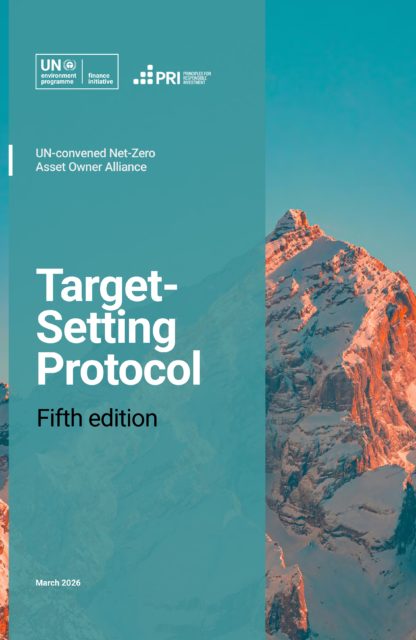
NZAOA releases the fifth version of foundational document the Target-Setting Protocol reflecting NZAOA's commitment to continuous improvement.
Banking, Climate Change, Events, Webinars | 19 February 2026
Transition planning is not only a regulatory or market-driven requirement—it is a core enabler of a bank’s portfolio composition, client engagement, and stakeholder and partnership strategies. This webinar will discuss UNEP FI's recently published report on transition plans including key drivers, market developments and sectoral transition levers.

Events, Social, Webinar, Webinars | 16 February 2026
This discussion will reflect UNEP FI’s global work with banks and insurers to translate just transition principles into real-world decision-making across diverse regional and sectoral contexts. It will coincide with the launch of the final report from the Just Transition Pilot Programme, which presents 13 in-depth case studies of financial institutions developing and applying new tools, frameworks and financing approaches to support a fair and inclusive climate transition.

Podcasts, Risk | 12 February 2026
In this episode of Financing the Future, Carine Smith Ihenacho of Norges Bank Investment Management discusses how the world’s largest sovereign wealth fund approaches climate risk, ESG and long-term value creation. She explains why climate risk remains financial risk, how investors navigate geopolitical volatility and regulatory change, and why prioritizing financially material sustainability issues is essential for long-term returns.

Impact Centre, News | 09 February 2026
Understanding and managing impacts is essential for organizations to manage their risks and operate sustainably. Our current SDGs & Impact…

Climate Change, Events, Policy, Risk, Webinars | 28 January 2026
In this webinar, NGFS will provide practical insights on how financial institutions can utilize this guide to enhance their scenario analysis practices and stay abreast of upcoming regulatory requirements related to scenario analysis and stress-testing.
