
19 December 2023Banking, Climate Change, Impact, Insurance, Investment, Nature, News, Policy, Pollution & Circular Economy, Social
POPULAR CONTENT
19 December 2023Banking, Climate Change, Impact, Insurance, Investment, Nature, News, Policy, Pollution & Circular Economy, Social

19 December 2023Climate Change, News

18 November 2012News
Nature should be viewed as a form of critical infrastructure. This briefing explores how ecosystem condition shapes climate-related risks and introduces the PSI Climate–Nature Nexus Atlas, a practical resource to support nature-aware underwriting.
Prepared by the Principles for Sustainable Insurance (PSI) and the UNDP Insurance and Risk Finance Facility (IRFF) for CBD COP17, this briefing explores how insurers can support implementation of the Global Biodiversity Framework through risk management, risk transfer and investment, while highlighting priorities for scaling insurance for nature and strengthening resilience through healthy ecosystems.
In the two years since COP16 in Cali, Colombia, the finance sector has made significant progress in building the foundations for nature finance. Yet financial flows remain fundamentally misaligned with global biodiversity goals. UNEP FI's 2026 report card finds that stronger action by financial institutions, alongside clearer government policies and regulations, is needed to meet the 2030 targets of the Kunming-Montreal Global Biodiversity Framework.
This UNEP FI policy brief examines how nature-related considerations are being incorporated into banking-relevant regulation across the two major economic and financial systems of China and the European Union. It aims to to help financial sector practitioners and policymakers understand how nature-related considerations are being incorporated into banking-relevant regulation in the two jurisdictions, within a rapidly evolving global landscape.
The Ocean Investment Protocol offers a framework for financial institutions, policy makers and industry leaders to lead this transition. First published in 2025, this updated edition reflects developments in the sustainable ocean finance landscape and highlights new priorities; including stronger action by central banks, regulators, and supervisors and better integration of ocean considerations into financial decision-making.
This guide helps risk professionals at banks gather the information they need to monitor and manage nature-related risks and opportunities across their portfolios. Structured around ten questions, the guide helps banks better understand their nature-related impacts, capabilities, and management practices – and turn that understanding into greater resilience and future opportunities.
This report provides commercial banks, particularly signatories to the Principles for Responsible Banking (PRB), with a practical framework for understanding how circular economy solutions can address nature-related dependencies, impacts, risks and opportunities across three ecosystem categories: ocean and marine, freshwater, and terrestrial and land-based ecosystems.
This guidance, co-developed with Equator Principles, supports project-related financing teams as well as risk professionals within financial institutions, particularly banks, by outlining how to conduct a nature-based risk assessment at the corporate, portfolio and project levels using existing frameworks and tools. It highlights how nature-based risk assessments can improve risk identification, strengthen due diligence, enhance collaboration with clients, and support better decision-making across project finance and portfolios.
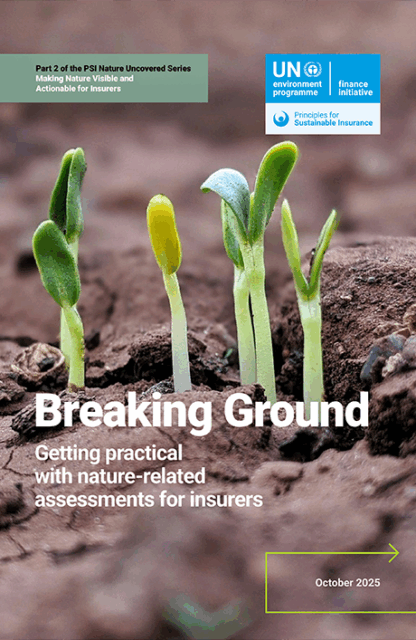
The latest report from the PSI Working Group for Nature is the second in the “Nature Uncovered for Insurers” series,…
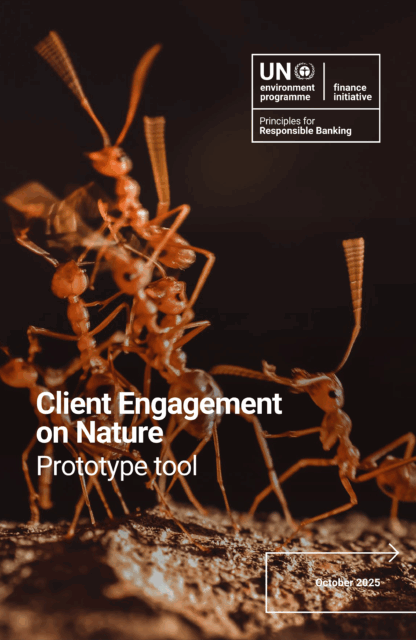
Banks are increasingly talking to their clients about nature but knowing which questions to ask to understand the impact and reliance of their businesses on nature is not always clear. This prototype is an excel-based tool intended to assist banks—and specifically relationship managers—to formulate succinct, meaningful questions as part of client engagement on nature.