


Latest News
- July 2026 – A new edition of the Impact Radar is now available, as well as a new iteration of the Sectors Mapping, now called the Sector Impact Matrix. Read more here.
 The Impact Radar is a structured compilation of sustainability topics designed to help organizations identify, assess and manage their positive and negative impacts on people, society and the environment. It can be used by private finance and business to understand and manage positive and negative impacts across the three pillars.
The Radar is based on internationally recognized standards and definitions, with an aim to foster a common language among private sector practitioners, sustainability initiatives and standards, policymakers and regulators by creating a shared, open-source nomenclature of sustainability issues.
- Download the Impact Radar (2026) here
About the 2026 Edition
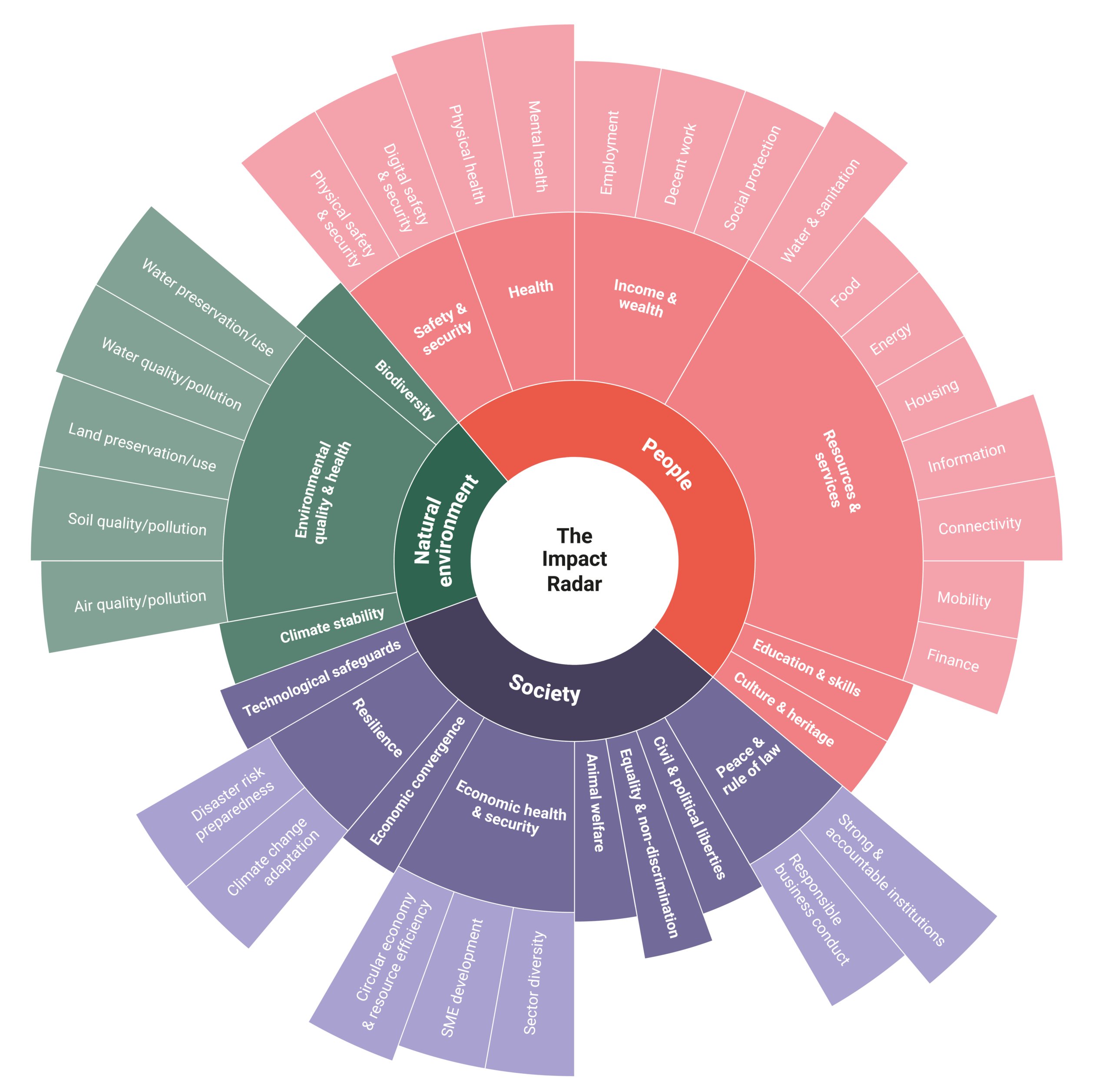
Faithful to its origins, the 2026 edition remains rooted in UNEP FI’s “holistic impact” approach, which recognizes the triple dimensions of sustainability (social, socio-economic and environmental) and the deeply interconnected nature of all sustainability issues.
As with the last edition, the present edition of the Radar was prepared to reflect the lessons learned from years of experimentation and usage by the diverse community of practice both within and beyond UNEP FI’s membership. The 2026 edition has also benefitted from UNEP FI’s involvement with of the Impact Management Platform (IMP), a collaboration between leading providers of public good standards and guidance for managing sustainability impacts.
Key Features:
- An explanation of the conceptual framework
- Definitions of the sustainability topics
- A high-level summary of how the Impact Radar topics relate to those in other frameworks and mappings
- Guidance for users of the 2022 edition of the Impact Radar
- FAQs
Going Further
The Radar is operationalized by a suite of Mappings which use the Radar topics to portray the likely positive and negative impacts of different sectors and activities (Sector Impact Matrix), or the status of
sustainability needs and priorities at the global and country levels (Needs Mapping).
These mappings can be used for a variety of purposes ranging from materiality assessments to counterparty screening, risk management and new product/service development. They can be used directly, or via UNEP FI’s Holistic Impact Tools which enable users to connect entity level data with the mappings.
Contact Us
Questions? Feedback? Interested in using the Radar to develop a resource? Developing interoperability solutions?
- Contact us via this form
Copyright © United Nations Environment Programme, 2026
This publication may be reproduced in whole or in part and in any form for educational or non-profit purposes without special permission, provided acknowledgement of the source is made. The United Nations Environment Programme Finance Initiative would appreciate receiving a copy of any publication that uses this publication as a source. No use of this publication may be made for resale or for any other commercial purpose whatsoever without prior permission in writing from the United Nations Environment Programme Finance Initiative.
The designations employed and the presentation of the material in this publication do not imply the expression of any opinion whatsoever on the part of the United Nations Environment Programme Finance Initiative concerning the legal status of any country, territory, city or area or of its authorities, or concerning delimitation of its frontiers or boundaries. Moreover, the views expressed do not necessarily represent the decision or the stated policy of the United Nations Environment Programme Finance Initiative, nor does citing of trade names or commercial processes constitute endorsement.
© Maps, photos and illustrations as specified
Disclaimer
It is our hope that the Impact Radar will be a source of inspiration to many organizations as they develop their in-house impact management capabilities and/or any advisory services and products on impact management for third parties.
Any resources, tools, systems, products or services developed based on, referring to or otherwise using the Impact Radar should acknowledge UNEP FI, however, the results, as well as any associated outcomes and decisions made based on such resources, are exclusively attributable to their developers and their own interpretation of the Impact Radar. In no case may these be assumed to be aligned with UNEP FI’s views and methodologies and/or to have been validated, approved or otherwise certified by UNEP FI.
UNEP FI does not provide advisory services or certification for any resources, tools, systems, products or services developed based on, referring to or otherwise using the Impact Radar.